PA Resources
Completes Drilling of Appraisal Well In Equatorial
Guinea
Noble Energy
Announces Block I Well Results in Equatorial Guinea
Acuerdos de
exploración conjunta de los recursos petroleros entre
Guinea
Ecuatorial
y Sao Tomé y Príncipe en la zona limítrofe entre los dos
países
3 de marzo
de 2008
El presidente de Sao Tomé y Príncipe, Fadrique de
Menezes, visitó Malabo la pasada semana. Resultado de
este viaje ha sido la firma de un memorandum para la
exploración conjunta de los recursos petroleros en la
zona fronteriza entre los dos países. La página Macauhub
lo cuanta así: "São Tomé e Príncipe y Guinea Ecuatorial
quieren establecer un acuerdo de exploración conjunta
del bloque de petróleo situado en la zona de
delimitación marítima entre los dos países, anunció el
viernes el presidente ecuatoguineano, Teodoro Obiang
Nguema.
El anuncio hecho por Obiang Nguema fue difundido por la
televisión nacional de São Tomé e Príncipe, TVS, en un
reportaje “balance” sobre la visita del jueves del
Presidente de Sao Tome, Fradique de Menezes, a Malabo,
capital de Guinea Ecuatorial, inscrito en el ámbito de
la cooperación bilateral.
Admitiendo la hipótesis de la existencia de un bloque de
petróleo situado en las fronteras marítimas de los dos
países, el Jefe del Estado ecuatoguineano indicó que
“estamos estudiando la posibilidad de una exploración
conjunta del boque de la zona de delimitación”.
Nguema defendió también la distribución de los ingresos
resultantes de la exploración conjunta conforme a la
potencialidad de los posibles yacimientos encontrados y
su localización en la frontera marítima de los dos
Estados, en la zona del Golfo de Guinea, en la costa
occidental de África, separados por una distancia de
unos 300 kilómetros.
El acuerdo, en el que participarán también las empresas
petroleras interesadas, se preparará por una comisión
mixta de las dos partes así como por consultores
internacionales, según un memorando básico firmado el
viernes en Malabo por los respectivos presidentes,
Fradique de Menezes de São Tomé e Príncipe y Teodoro
Obiang Nguema de Guinea Ecuatorial.
Mientras Guinea Ecuatorial dispone ya de experiencia en
temas de exploración petrolera, Sao Tomé iy Principe
está en una fase inicial de esa actividad con una zona
marítima exclusiva cuya prospección en bloques está
prevista para finales de año, junto con otra zona de
exploración conjunta con Nigeria, en la que los
descubrimientos hechos, no justifican todavía una
explotación comercial.
Además del sector petrolero, el acuerdo de cooperación
entre São Tomé e Príncipe y Guinea Ecuatorial implica
también a sectores forestales, infraestructuras,
educación y transporte".
Guinée
équatoriale: Démarrage de production pour la
compagnie pétrolière Amerada Hess de son
deuxième gisement de brut en Guinée
équatoriale avec une extraction à terme 60
000 barils par jour pendant vingt ans
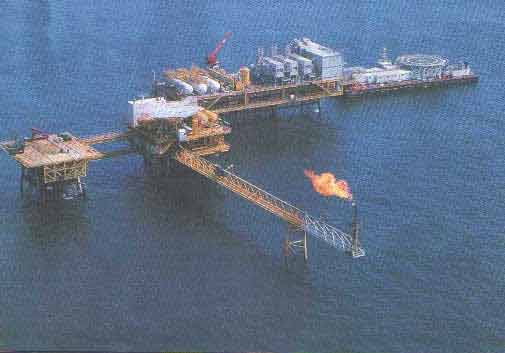
MALABO, 13 fév 2007 - La compagnie
pétrolière américaine Amerada Hess a donné
lundi le coup d'envoi de la production de
son deuxième gisement de brut en Guinée
équatoriale, "Okumé", dont devraient être
extraits à terme quelque 60.000 barils par
jour, a rapporté mardi la radio nationale.
Inauguré par le président équato-guinéen
Teodoro Obiang Nguema et le président de la
compagnie américaine John Hess, ce champ
offshore, situé à une trentaine de
kilomètres au large de la ville continentale
de Bata, devrait produire "pendant une
période approximative de vingt ans", selon
M. Hess. Le complexe "Okumé", dont
l'aménagement a coûté un milliard de
dollars, est opéré par Amerada Hess en
coopération avec la société nationale
équato-guinéenne de pétrole (Gepetrol) et la
compagnie britannique Tullow Oil - Energy, a
indiqué à l'AFP une source pétrolière.
Amerada Hess est présente depuis cinq ans en
Guinée équatoriale, où elle exploite un
autre champ offshore baptisé "Ceiba" au
large de Bata, avec une production d'un peu
plus de 45.000 barils par jour. Une dizaine
de sociétés, pour l'essentiel américaines,
exploitent depuis le début des années 1990
le pétrole de Guinée équatoriale, troisième
producteur de brut d'Afrique subsaharienne
derrière le Nigeria et l'Angola.
Devon Energy Agrees to Sell Assets in
Equatorial Guinea for $2.2 Billion
Noble
Energy Announces Additional Discovery on
Block 'I' in Equatorial Guinea
"El
petróleo no es eterno...".
"Continúa
la avalancha petrolera y se
diversifican los operadores.
Sin embargo, algunos se
preparan ya para el futuro,
interesándose
fundamentalmente por el gas.
Iniciando en septiembre
la relación con el gigante
ruso Gazprom, un año después
de haber invitado a los
chinos, el presidente
Teodoro Obiang Nguema
Mbasogo busca, sin duda
alguna, salir de su
dependencia respecto a las
empresas norteamericanas,
haciendo jugar plenamente la
competencia y sacar mayores
beneficios de las
concesiones petroleras.
Quedan lejos los tiempos en
los que el Estado sólo
recibía el 3 % de los
beneficios obtenidos en el
campo Alba y el 5% de los
del Zafiro y Ceiba. Tras más
de catorce años de
explotación, las autoridades
han reencontrado el sentido
de la negociación. El
sistema actual establece
royaltys de entre el 10 y el
16 % de la producción, una
participación de las
empresas estatales en las
filiales americanas en
Guinea Ecuatorial y una
transferencia del 15% de los
beneficios en lugar del 3 %
en los años 1990. Sin
embargo, las tres cuartas
partes de los ingresos van
todavía a los bolsillos de
las compañías extranjeras.
“Por eso les hemos impuesto
una renegociación global de
los contratos que nos ligan
con ellas. La gran mayoría
de estas empresas han
recuperado ampliamente sus
inversiones y es ya tiempo
para que se aumente la parte
que nos transfieren…
Aspiramos al 40 o al 50 %,
incluso más », explica el
jefe del Estado, sensible al
combate de su homólogo
venezolano Hugo Chávez
contra la grandes empresas
petroleras occidentales.
Esta política se ha
vuelto imperativa, aunque
las autoridades sigan
gestionando sus ingresos con
parsimonia, el maná va a
disminuir progresivamente a
partir de 2008, año en el
que se prevé el pico de la
producción. Las extracciones
de petróleo y de gas se
aproximarán a los 580 000
barriles por día – frente a
los 400 000 actuales- antes
de disminuir a la par que lo
hace el principal yacimiento
de bruto, el Zafiro.
Iniciada su producción a lo
largo de la isla de Bioko en
1995, este campo ha
enriquecido a la compañía
norteamericana ExxonMobil,
cambiado el aspecto del país
y el tren de vida de sus
dirigentes. Pero su ciclo de
producción va a disminuir
rápidamente, el ritmo de
extracción bajará de los 100
000 b/d. en 2013, frente a
los 250 000 en la hora
actual. A corto plazo, las
perdidas se compensarán en
parte por la entrada en
explotación del yacimiento
Okoumé, que permitirá hacer
pasar la producción de
Amerada Hess, otra gran
empresa petrolera
norteamericana, de 50 000 a
100 000 b/d. Pero sobre todo
por el desarrollo del
potencial gasistico,
estimado en 40.000 millones
de metros cúbicos.
El viceministro de Minas,
Energía y de Industria,
Gabriel Mbegha Obiang Lima,
se dedica igualmente a poner
en valor el offshore
profundo y las concesiones
de la parte continental.
Recorre el mundo para
preparar la entrada de
nuevas operadoras.
¡Con un cierto éxito!
La brasileña Petrobras
anunció el 11 de enero haber
conseguido luz verde del
gobierno para hacerse cargo
del 50 % de una concesión en
la cuenca del río Muni
(entre 500 y 2 200 metros de
profundidad). Otros grandes
grupos están en fase de
explotación, entre ellos la
malasia Petronas, la
nigeriano-noruega Dangote
Energy Equity Resources
(EER) y la española Repsol.
“Algunos han hecho
hallazgos interesantes, pero
su explotación dependerá de
la evolución de los
contratos de participación
en la producción y de los
precios del petróleo dada la
importancia la amplitud de
las inversiones que se
necesitan» explica un asesor
del FMI. Además, otras
Varias compañías han
expresado su interés por
concesiones situadas al sur
de la isla de Bioko y en el
entorno de Annobon.
A largo plazo, podría
levantarse el secreto
[lómerta financiero. Aunque
las cuentas de Gepetrol y
Sanagaz no se presentan a
los parlamentarios, las
autoridades han manifestado
su intención de adherirse a
la Iniciativa internacional
para la transparencia de las
Industrias Extractivas
(EITI). Guinea Ecuatorial
dispondría de mas de un
millón de francos CFA de
reservas financieras,
constituidas gracias a los
ingresos petroleros. Los
proveedores de fondos
internacionales animan al
gobierno a que alimente la
cuenta de reservas para las
generaciones futuras y
llaman a las autoridades a
hacer inversiones en los
ámbitos de las
infraestructuras públicas,
de la educación y de la
sanidad. Según el FMI, el
80% de la población vive
todavía en la pobreza
mientras que el PIB por
habitante alcanza en la
actualidad los 11.000
dólares por año".
Los artículos del
corresponsal de Jeune
Afrique tienen siempre
aspectos de interés, pero
acaban mostrando siempre
demasiadas concesiones para
con la dictadura
ecuatoguineana. De interés
en este caso es el que ponga
el acento en el futuro de la
producción de gas que irá
sustituyendo al petróleo en
los próximos años en Guinea
Ecuatorial, es también de
interés el que se refiera
abiertamente a las
condiciones de abuso en las
que las grandes compañías
americanas (apoyadas por el
dictador) iniciaron la
producción petrolera a
mediados de los años noventa
y la continúan en la
actualidad y que no olvide
nunca que sobre el gris
esplendor de las condiciones
de vida de una minoría
reposa sobre la mísera de la
gran mayoría de la población.
Concesiones a la
dictadura es pretender que
el régimen ecuatoguineano
mantiene serias diferencias
con estas petroleras o que
las nuevas leyes del
petróleo suponen un intento
serio de poner coto a sus
excepcionalmente ventajosas
condiciones de producción.
Las relaciones (oscuras
relaciones) del régimen
ecuatoguineano con las
grandes petroleras
norteamericanas son
imprescindibles para su
pervivencia política y
Obiang lo tiene muy presente
aunque se permita alguna
crítica contra ellas,
destinada a mantener viva
alguna brizna de
nacionalismo entre su
parroquia o ante la opinión
pública africana. [La
alusión que se hace a Hugo
Chávez no puede
interpretarse mas que como
un chiste].
Concesiones a la
dictadura es presentarla
como un régimen normal,
preocupado por algún
problema del país y no por
el simple enriquecimiento de
sus integrantes, capaz, por
si solo, de evolucionar a
situaciones de normalidad o
de transparencia. La
democracia, la transparencia,
la existencia de un gobierno
preocupado por la situación
del país llegarán a Guinea
Ecuatorial (porque llegarán,
pueden estar seguros) contra
la voluntad de Obiang y los
suyos..
A
little suburban Houston company has made a big grab to
drill for oil in a largely unexplored area off the coast
of Africa. Hyperdynamics Corp., a 22-employee company,
is getting in the offshore Africa drilling game with a 31,000-square-mile
concession off the Republic of Guinea that's about the size of South
Carolina.Plenty
of rigs dot the offshore West Africa seascape, particularly along
oil-rich countries such as Nigeria, Equatorial Guinea and Angola.
But the vast area off Guinea's coast, directly west of Nigeria, is
pretty quiet;
Hyperdynamics,
which is publicly traded on the American
Stock Exchange, hopes to change that.
"We ended up being in the right place at the
right time," said Mike Watts, a consultant
on investor relations and business
development for the company, which is run by
his brother, Kent Watts.
Mike Watts said Sugar Land-based
Hyperdynamics, once a data-oriented
technology company that turned to oil and
natural gas after the tech bust of 2000, got
its foot in the door with software that
converted data on old seismic tapes to DVDs.
Hyperdynamics also shot seismic data to help
oil companies scout out oil and gas.
In 2002 Hyperdynamics shot seismic off
Guinea's coast for USOil Corp., which had
obtained the concession years earlier. Watts
said that data showed a promising oil
presence.
Eventually Hyperdynamics took over
negotiating an agreement with Guinea's
government to explore the concession, and
signed it in September.
The agreement -- which has yet to be
ratified by Guinea's National Assembly --
says 36 percent of the concession is
Hyperdynamics' to explore. The company has
the right to participate in any development
in the remaining 64 percent.
Greg Priddy, an analyst with Eurasia Group,
a New York-based political risk advisory and
consulting firm, said he wasn't familiar
with Hyperdynamics, but he's not surprised
at an effort to tap a largely untapped area.
"There hasn't really been a significant
amount of development in the Republic of
Guinea offshore before," he said. "It's not
surprising if they were inviting foreign
companies in. There have been offshore finds
in other places in that area."
Brad Richards, a partner in the
international practice group for law firm
Haynes and Boone in Houston, called the area
"truly speculative" because it hasn't
attracted other players.
"It is a rare thing to be able to obtain
rights to an area that is so large. It's an
extraordinary opportunity, but only if there
is something there. You can obtain all
rights to drill in Poland, but nobody's
found any oil and gas there," he said.
However, if drilling proves successful and
demonstrates potential in the area, "then
you'll have a lot of people diving in,"
Richards said.
Another reason the area is largely an
untapped frontier could be Guinea's low
ranking in the 2006 Corruption Perceptions
Index survey of 163 countries by
Transparency International, a Berlin-based
watchdog group, said Art Smith, an analyst
with John S. Herold.
The 2006 survey ranks Guinea 160th -- just
above Iraq, Myanmar and Haiti. Finland ranks
first as the least corrupt in the survey.
The U.S. is 22nd.
Such rankings don't keep U.S. companies away
if oil is there. Angola ranks 142nd, Nigeria
146th and Equatorial Guinea 154th in the
2006 survey. And Guinea's ranking didn't
concern Kent Watts.
"We've invested heavily in understanding the
government and how they work. We're also
working with our government over there to
make sure that everything is done properly,"
he said.
Dianne Sutherland, chief editor of Petroleum
Africa Magazine, noted that exploration and
production are ongoing off the shores of
Guinea's neighboring countries.
"Once Hyperdynamics makes a
find, they will likely turn over acreage or
turn back some acreage to focus on smaller
areas. The government will most likely
attract other people to explore those areas
Hyperdynamics no longer looks at."
The company has contracted with Applied
Technology Drilling, a subsidiary of
Houston-based drilling contractor
GlobalSantaFe, to assess the drilling
infrastructure.
Hyperdynamics had $656,000 in revenue in the
fiscal year that ended June 30 and logged a
$7.5 million net loss in the same period,
the filing said.
The company acknowledged in its annual
filing with the Securities and Exchange
Commission that it relies on third parties
for production services and processing
facilities.
"We can share some risk, which is usually
the prudent thing to do," Kent Watts said.
Copyright (c) 2006, Houston
Chronicle. Distributed by McClatchy-Tribune
Business News.
About RigLogix
RigLogix is the exciting offshore rig data
system developed and operated by
Rigzone.com. Designed to meet the needs of
rig fleet owners and operators, equipment
providers, analysts, and producers, RigLogix
is the most comprehensive rig data
repository coupled with the most advanced
industry data analysis toolkit and reporting
engine on the market
Le pétrole n’est pas éternel…
La
ruée vers l’or noir se poursuit et
les opérateurs se diversifient.
Mais, d’ores et déjà, certains
préparent l’avenir, en s’intéressant
au gaz notamment.
En ouvrant la filière hydrocarbures
au géant russe Gazprom en septembre,
un an après y avoir invité les
Chinois, le président Teodoro Obiang
Nguema Mbasogo cherche
indubitablement à sortir de sa
dépendance à l’égard des compagnies
américaines en faisant jouer à plein
la concurrence, et à tirer le
meilleur bénéfice des concessions
pétrolières. Il est loin le temps où
l’État ne percevait que 3 % des
bénéfices réalisés sur le champ
d’Alba et 5 % de ceux de Zafiro et
de Ceiba. Après plus de quatorze ans
d’exploitation, les autorités ont
retrouvé le sens de la négociation.
Le système actuel prévoit des
royalties comprises entre 10 % et 16
% de la production, une
participation des sociétés d’État
dans les filiales américaines
opérant en Guinée équatoriale et le
reversement de 15 % des bénéfices au
lieu de 3 % dans les années 1990.
Néanmoins, les trois quarts des
revenus vont encore dans les poches
des compagnies étrangères. « C’est
pourquoi nous leur avons imposé une
renégociation globale des contrats
qui nous lient à elles. La plupart
de ces sociétés ont largement
récupéré leur investissement, et il
est temps pour nous d’augmenter la
part qui nous revient… Nous visons
40 % à 50 %, voire plus », explique
le chef de l’État, sensible au
combat de son homologue vénézuélien
Hugo Chávez contre les majors
occidentales.
Cette politique est d’ailleurs
devenue impérative, alors que les
autorités auront à gérer leurs
revenus avec parcimonie, la manne
devant diminuer progressivement à
partir de 2008, année prévue du pic
de production. Les extractions de
pétrole et de gaz avoisineront alors
les 580 000 barils par jour (b/j) -
contre 400 000 à l’heure actuelle -
avant de diminuer avec la poursuite
du déclin du principal gisement de
brut, Zafiro.
Entré en production au large de
l’île de Bioko en 1995, ce champ a
fait la fortune de la compagnie
américaine ExxonMobil, changé le
visage du pays et le train de vie de
ses dirigeants. Mais sa courbe de
vie va désormais rapidement
s’infléchir, le rythme d’extraction
devant passer sous la barre des 100
000 b/j en 2013, contre 250 000 à
l’heure actuelle. À court terme, les
pertes seront en partie compensées
par l’entrée en exploitation du
gisement d’Okoumé, qui permettra de
faire passer la production d’Amerada
Hess, autre major américaine, de 50
000 à 100 000 b/j. Mais surtout par
le développement du potentiel
gazier, estimé à de 40 milliards de
mètres cubes.
Le vice-ministre des Mines, de
l’Énergie et de l’Industrie, Gabriel
Mbegha Obiang Lima, s’emploie
également à valoriser l’offshore
profond et les permis de la partie
continentale. Il sillonne le monde
pour préparer l’entrée de nouveaux
opérateurs. Avec un certain succès !
Le Brésilien Petrobras a annoncé le
11 janvier avoir obtenu le feu vert
du gouvernement pour prendre 50 %
des parts d’une concession dans le
bassin du fleuve Muni (entre 500 et
2 200 mètres de profondeur).
Plusieurs autres grands groupes sont
en phase de recherche, notamment le
malaisien Petronas, le
nigériano-norvégien Dangote Energy
Equity Resources (EER) et l’espagnol
Repsol.
«
Certains ont fait des découvertes
intéressantes, mais leur
exploitation dépendra de l’évolution
des contrats de partage de
production et des cours du pétrole
compte tenu de l’ampleur des
investissements », explique un
conseiller du FMI. Plusieurs
compagnies ont, par ailleurs,
exprimé leur intérêt pour des
concessions situées au sud de l’île
de Bioko et autour de celle
d’Annobon.
À
terme, l’omerta financière sur la
filière pourrait être en partie
levée. Si les comptes de la Gepetrol
et de la Sonagaz ne sont toujours
pas présentés aux parlementaires,
les autorités ont manifesté leur
volonté d’adhérer à l’Initiative
internationale pour la transparence
dans les industries extractives (EITI).
La Guinée équatoriale disposerait de
plus de 1 000 milliards de F CFA de
réserves financières constituées
grâce aux revenus pétroliers. Les
bailleurs de fonds encouragent le
gouvernement à alimenter le compte
d’épargne pour les générations
futures et appellent les autorités à
investir en priorité dans les
domaines des infrastructures
publiques, de l’éducation et de la
santé. Selon le FMI, 80 % de la
population est encore victime de la
pauvreté alors que le PIB par
habitant s’élève aujourd’hui à 11
000 dollars par an.
http://www.jeuneafrique.com/jeune_afrique/article_afrique_dossier.asp?dos_id=233
GUINÉE
EQUAT. - 24 décembre 2006 - par
PASCAL AIRAULT
Recent
developments in Equatorial Guinea
United States sponsored
secret flights and clandestine detention
centres in Europe and elsewhere have
received plenty of comment recently.
Politicians and journalists tell us the ”war
on terror” demands extreme measures. At the
same time, in countries which have nothing
to do with that ”war”, detainees are held
incommunicado, without effective judicial
protection and routinely tortured in
carefully ignored prisons. Reports about
conditions in Iraq and Afghanistan are
widespread, but almost little appears about
what is going on in Equatorial Guinea, a
country friendly to the West. One of
Equatorial Guinea´s prisons, surrounded by a
tropical sea, has the same name as a
relaxing California beach : Black Beach. In
spite of this, it is not a sunny spot in a
lost paradise. It is an ugly compound in
Bioko Island, near Malabo, Equatorial
Guinea´s capital.
This tiny country of 28.000 square
kilometres and 500.000 inhabitants is
located on West Africa´s Gulf of Guinea
between Cameroon and Gabon. Until
independence in 1968, it had been a Spanish
colony for almost 200 years. Since the
landmark ”scramble for Africa” Berlin
Conference in 1884, it has been known mainly
for its cocoa production, endless penury,
dictatorships and the natural beauty of its
jungles and beaches.
Until recently nothing much seemed to
change, except now for the beauty and the
cocoa, both for the worse. The country´s
beauty is being mercilessly spoiled by
pollution from the offshore oil industry and
intensive timber exploitation. The oil
industry is controlled by head of State,
Teodoro Obiang Nguema, who seized power from
his uncle, through a coup in 1979. Timber
production is controlled by the Minister of
Forestry, Obiang´s eldest son. Cocoa
production, formerly run by colonial
entrepreneurs, has nose-dived since
independence when international pressure
ended Spanish rule.
Following independence, dictatorship and
neo-colonialism (globalization in modern
parlance) have grown and are now even
stronger than before. The prison at Black
Beach is an glaring example of their
perverse synergy, compounded by the effects
of extreme poverty on the general
population. Dictatorship and neo-colonialism
work hand in hand, greased by oil. Wealth
from the oil industry over the last ten
years has not trickled down to the
population, its legitimate owner. Instead,
it is channelled overseas to benefit Obiang
and his entourage and the foreign
corporations that back them. Equatorial
Guinea is the paradigm of the ”curse of
natural riches”.
Governments in Western capitals know this
very well. International agencies and human
rights organisations routinely criticise
General Obiang´s rule. However, those
Western governments increasingly support him,
steadily developing economic, political and
military ties with his regime. When it suits
them, the United States and Spanish
governments, two of Obiang´s major trading
partners and close supporters, declare a
willingness to cooperate with Equatorial
Guinea´s government in what they call its
”democratization process”.
This and similar statements appear in the
media to mark political summits and official
visits. The Spanish Foreign Affairs Minister
told the Spanish Parliament after a visit to
Equatorial Guinea in 2005, ”the President
asked Spain to accompany him in his
endeavours to modernise the State and reform
the administration”. In response, the
Minister said the Spanish government was
fully devoted to this task, although
remaining ”extremely critical and mindful
concerning the rule of law and encouragement
of those citizens willing to contribute to
Equatorial Guinea´s democracy and political
life”.
Some of this ”democratization process, was
reported in a press conference in June 2006
by Weja Chicampo, leader of the banned MAIB
(Movement for the Self-determination of
Bioko Island). Chicampo arrived in Madrid
after being expelled from his own country by
Obiang. During the two years, three months
and two days he spent in Black Beach,
without proper charges, trial or legal
assistance, he says, ”they (the jailers)
beat me until I lost my vision; then, after
some more beating, I lost consciousness. My
family and children were terrified. From
that moment on a long agony starts and it
will last for days, weeks...... In order to
give you an idea I can say that I was
handcuffed for four months in a row. There
were many other instances of torture like
this.” (Chicampo press conference of June
22nd, 2006.)
The number of political prisoners in
Equatorial Guinea has averaged 200 in the
last six years. A proportionate comparison
would mean a figure of 20.000 in Spain. It
must be noted that some detention centres
escape any kind of control. Prisoners have
no contact with the outside world. They
remain at the mercy of their jailers and the
jailers´ boss: General Obiang. Chicampo
reports that ”there are transfers from Black
Beach to other detention centres, in order
to obstruct access of Red Cross teams to the
prisoners while visiting facilities. I was
transferred to a military prison (Acacio
Mañé Military Unit) on April the 5th, 2004.
Other prisoners that should not be seen were
transferred to Punta Fernanda and other
places”.
The Spanish government has plenty of
information about this reality and about the
torture. But this does not prevent it from
cooperating with the dictatorship in
Equatorial Guinea even as, together with
other European Union governments, it demands
the closure of the US government´s
Guantánamo prison in Cuba.
The United States government too has the
same information. Its Department of State
has even made it partially public in its
annual reports. The one released in March
2006 notes of Equatorial Guinea: ”The
government´s human rights´ record remained
poor, and the government continued to commit
or condone serious abuses... security forces
reportedly killed several persons through
abuse and excessive force... The following
human rights problems were reported:
arbitrary arrest, detention, and
incommunicado detention... There were
reports of politically motivated
kidnappings, there were continuing reports
of government figures hiring persons in
foreign countries to intimidate, threaten,
and even assassinate citizens in exile.”
What can ”abuse and excessive force” be
except mealy-mouthed diplomatic jargon for
torture?
Despite this, inter-governmental relations
are excellent, according to the US
ambassador in Malabo. In his 2005
Independence Day remarks at the US embassy,
in front of Obiang and some members of
Obiang´s regime, he said: ”We value our
relations with Equatorial Guinea and are
pleased that they are excellent and indeed,
growing closer. I personally had the
pleasure of accompanying his Excellency
President Obiang Nguema Mbasogo on his June
visit to Baltimore and Washington. In both
cities, the President was well-received.
Among both business and government leaders,
he made an excellent impression and called
effective attention to further opportunities
to strengthen our relationship.”
Beyond the specious political discourse,
attention should really focus on the United
States´ role in Equatorial Guinea: the
enormous growth of its oil industry and the
consolidation of dictatorship in the face of
mounting internal opposition and foreign
criticism. United States oil companies
operating in Equatorial Guinea have made it
the third largest African oil producer South
of the Sahara in just ten years of
industrial activity. The US embassy,
formerly closed because of political
differences with the Obiang regime, as was
hinted at in the State Department report
quoted above, was reopened once the oil
companies established themselves, even
though the dictatorship did not change its
policies.
A review of the hard facts corrects the
ambassador´s rosy picture. ExxonMobil,
Chevron-Texaco, Amerada Hess, Marathon Oil
and other companies transfer vast profits to
the United States from exploiting Equatorial
Guineas´s oil. For exploitation rights these
companies pay huge sums of money directly to
Obiang and his family into United States
bank accounts. It is crystal clear that
these sums should benefit all the people of
Equatorial Guinea, not just the ruling
family. But that is not happening.
The European Union has reported: ”Equatorial
Guinea´s GDP growth was the world´s highest
between 1995 and 2001 and well above average
growth in the region ...although it had one
of the lowest only ten years ago. However,
this increase in resources has not yet been
matched in the social sphere by a similar
improvement in the living conditions of the
population, which still show worrying
indicators.”
Equally illustrative of the level of
corruption among the country´s elite are the
findings of the United States Senate
Permanent Subcommittee on Investigations in
their ”Money Laundering and Foreign
Corruption” report, made public on July
15th, 2004. Among other issues, the report
deals with Obiang´s - and his family´s -
accounts in Riggs Bank: ”The Subcommittee
investigation found that Riggs opened
multiple personal accounts for the President
of Equatorial Guinea, his wife, and other
relatives.” The total amount of bank
deposits held by Obiang in the United States
and other countries is unknown, but it is
believed that to exceed seven hundred
million US dollars, in addition to the value
of luxurious villas and other real estate
investments.
In the meantime, Equatorial Guinea´s Human
Development Index is near the bottom of the
medium human development group: position 121
out of 177 countries in the UNDP 2005 Human
Development Report. The country has
experienced some minimal improvement: in
1999, it was in position 131 out of 174 with
GDP per capita (PPP$) 1.817 in 1999, while
in 2005 it was 19.780. The fact that not a
single country in this medium human
development group has a similar current GDP
per capita indicates the grotesque injustice
of wealth distribution in Equatorial Guinea.
Self-evidently, the triangle in Equatorial
Guinea formed by Obiang´s dictatorship, the
country´s oil wealth and Western economic
interests results in prisons like Black
Beach and another one in Bata (second most
important city in the country). In other
words: the Obiang clan´s machinations
thoroughly greased by United States oil
companies, have turned them into plutocrats
amidst an impoverished, oppressed
population, who barely enjoy even the most
meagre crumbs while the dictator´s family
and the oil companies feast.
General Obiang is a dictator. Backed by
Western governments, he denies fundamental
human rights to his compatriots. The United
States government and its allies
hypocritically tolerate Obiang´s
dictatorship so long as their international
companies enjoy rights to exploit Equatorial
Guinea´s oil wealth. While an exclusive
minority obtain huge benefits, the majority
only enjoy a notional ”democratization
process”, which in practice means occasional
fraudulent elections, Presidential birthday
”pardons” for prisoners, and empty political
speeches on Independence Day, all under the
complacent gaze of Western ambassadors.
Fuente: www.counterpunch.org//Genet
Fecha: 20/12/2006 7:06:00
Autor: agustin.velloso
publicado por: agustin.velloso
Palabras: 1680
Book Review: Fascinating story of coup
attempt is lost in the details
Web Posted: 12/01/2006 09:07 PM CST
Bob Davis
Special to the Express-News
The Wonga Coup
By Adams Roberts
Public Affairs, $26
In "The Wonga Coup," Adam Roberts presents a
confused, convoluted story of a coup attempt
in Equatorial Guinea, a small country in
west Africa consisting of both island and
main continent elements.
Of course, since the coup itself proved
muddled and messed up, perhaps it's natural
Roberts' book would suffer from similar
maladies. But one would expect an
experienced journalist of Roberts' caliber
to be able to sort it out a little more
effectively than he has done here.
"The Wonga Coup" basically tells the story
of the plotting and eventual failure of
mercenaries led by British aristocrat and
ex-SAS man, Simon Mann, to oust Equatorial
Guinea President Teodoro Obiang Nguema
Mbasogo (better known simply as Obiang).
Unfortunately, the story's many offshoots
and sidebars detract from the otherwise
interesting and fascinating subject of
greedy men attempting to depose the leader
of a nation in which they themselves are not
citizens. Revealing the plotters is driven
in part by a sense of adventure, but more so
by the hopes of great personal fortunes in
this oil-rich, virtually unknown west
African country. Roberts clouds the story by
the inclusion of too much detail, much of it
seemingly included solely for the purpose of
sensationalism.
His inclusion of an earlier 1973 attempt
seems to exist solely so he can accuse
Frederick Forsyth, author of the
best-selling "The Dogs of War," of plotting
the failed coup and then using the actual
information related to it as the basis for
the book, published in 1974. Forsyth
steadfastly denied having actually plotted a
coup and stated someone obviously
misunderstood when he dealt with actual
mercenaries, arms dealers and the like in
his research for the book.
Denials are also forthcoming from well-known
author Jeffrey Archer, whom Roberts claims
provided funds for the Wonga coup in 2004.
Archer has repeatedly denied his
involvement, and Roberts offers no concrete
proof that the J.A. Archer who provided
funds is indeed Jeffrey Archer.
Then there's the inclusion of material
related to the Riggs Bank. The bank, an old,
well-known establishment in America ended up
ruined because they banked Obiang's oil
revenues into personal accounts of Obiang
and his family. In short, they violated
American banking rules, but it's unclear
whether the attention of Congress and the
subsequent ruination of the bank stemmed
from the coup attempt raising the awareness
of American oil company actions in Obiang's
country or from other causes. In any event,
the Riggs Bank situation had nothing to do
with the Wonga Coup since it occurred well
after the coup attempt.
Unfortunately, instead of presenting a
straightforward description of the events as
they unfolded, with colorful background
added as necessary, Roberts tries to reveal
the actions and motivations of every person
involved, no matter how remotely connected
to the actual coup. In doing so, Roberts
bounces back and forth through time and
locations, creating a confusing picture
rather than a clear portrait of the
attempted coup. His efforts are further
hampered by the insertion of suppositions
and possible happenings interspersed with
hard facts. It almost seems as if Roberts
has some personal ax to grind with authors
Forsyth and Archer, Mark Thatcher and the
Riggs Bank.
The basic story of the Wonga Coup is
fascinating and intriguing. One has to
wonder how people with the experience of
Simon Mann and his co-plotters could have
been so lackadaisical about security, so
careless about getting the needed arms, and
so lax about assuming governmental approval
from the various governments. Or perhaps
they were careful about security, did take
special efforts to obtain the needed arms
and did try to verify the supposed approval
of South Africa, Spain, Zimbabwe and the
United States. You can't really tell because
Roberts hasn't presented the balanced,
well-organized coverage one would expect
from a journalist of his background
http://www.mysanantonio.com/entertainment/stories/MYSA120306.0P.book.wonga.10b6e89.html
Equatorial Guinea President Clears Higher
Oil Royalties
HOUSTON, Nov 28, 2006
(Dow Jones Newswires)
Equatorial Guinea's powerful President
Teodoro Obiang has ratified a new law that
increases the government's take in one of
Sub-Saharan Africa's fastest growing oil and
gas producing areas.
The legislation raises minimum royalties to
13% from 10%, mandates training for local
workers and includes regulations for the
petrochemical sector and the country's
nascent natural gas industry, according to a
document posted on the Oil Ministry's Web
site Nov. 24. Ministry officials couldn't be
reached for comment Monday.
The changes are modest in comparison to more
aggressive legal overhauls undertaken by
Bolivia and Venezuela, but just like those
countries, the small West African republic
seeks a bigger share of the oil rent. The
legislation is expected to incrementally
diminish profits for Exxon Mobil Corp. (XOM)
and other U.S. companies that dominate
oilfield development in Equatorial Guinea,
all of whom either declined comment or said
they weren't familiar enough with the
changes to substantively address them.
"They are just harmonizing and modernizing
their laws to reflect the fact that their
hydrocarbon sector has grown considerably
since they first put their laws in place,"
said Monica Enfield, a Washington-based
Africa expert for PFC Energy.
Some new regulations, however, worry
observers. The new law opens the door for
the possibility of a windfall tax, and also
allows for the renegotiation of existing
contracts to grant the government a bigger
stake in oil and gas projects. It is unclear
whether the Equatoguinean government will
resort to these measures, though.
Devon Energy Corp. (DVN) spokesman Chip
Minty said the company is "in the process of
reviewing the new law to determine how it
will affect our business."
Marathon Oil Corp.'s (MRO) spokesman Paul
Weeditz said his company plans to
participate in upcoming meetings with
government representatives to review the
changes.
"It would be premature for us to comment at
this point until we have a chance to
thoroughly review this law and to
participate in the workshop that's going to
take place," Weeditz said.
Hess Corp. (HES) declined comment. A
spokeswoman for ExxonMobil, the country's
biggest producer, couldn't provide a comment
in time for publication.
Following the ratification of the new law,
the ministry extended the closing date of
its 2006 Licensing Round to March 31, 2007,
from Jan. 31 "in order to allow
pre-qualified companies to fully evaluate
the available acreage," according to a
ministry press release.
New Horizons
Equatorial Guinea, an impoverished former
colony of Spain, has been historically very
favorable to the foreign producers that
catapulted the country into Africa's energy
jet-set by exploiting its offshore resources.
In 2005, the country produced 356,000
barrels of oil a day, up from 5,000 barrels
a day 10 years earlier.
With the foundations of a thriving industry
in place, "new horizons have emerged," said
Obiang in a Nov. 3 document sanctioning the
law, which had been approved by the
Parliament in late September. Citing the
pending nature of presidential action,
ministry officials previously declined to
comment extensively on the changes.
Besides raising minimum royalties to 13%
from 10%, the law says that the state has
the right to a 20% share in contracts with
foreign operators. In addition, producers
will be required to pay "any windfall tax
that may be imposed by the state," according
to the law's text.
New natural gas regulations prohibit natural
gas flaring, although the ministry may
authorize some flaring upon request by
operators.
Producers are also required to train
Equatoguinean nationals to work on "all
levels of their organizations," and to help
pay for the training of ministry personnel
through annual disbursements, the law said.
The new laws bring Equatorial Guinea in line
with policies already implemented by other
increasingly demanding resource holders in
the developing world. The legislation "is
pretty consistent with what's going on in
the rest of the region," said PFC Energy's
Enfield.
Marathon, Equatorial Guinea Meet Dec 19 on
New Law
NEW YORK, Nov 30, 2006
(Dow Jones Newswires)
Marathon Oil Corp. (MRO) said Wednesday it
expects to get a better idea of what
Equatorial Guinea's new hydrocarbon law will
mean for the company's liquefied natural gas
(LNG) Train 1 project after a Dec. 19
meeting with the country's government.
The $1.4 billion project, in which Marathon
has a 60% interest, is on-budget and ahead
of schedule, with first shipments expected
in the second quarter of 2007.
The just-passed hydrocarbon law has raised
minimum royalties to 13% from 10%, mandates
training for local workers and includes
regulations for the petrochemical sector and
the country's nascent natural gas industry.
The Dec. 19 meeting is expected to afford an
opportunity for specific questions about the
law.
Steve Hinchman, senior vice president of
worldwide production, indicated that it was
his understanding that LNG trains would be
grandfathered in the wake of the law's
passage.
The Equatorial Guinea LNG company has
defined terms which will be applied to
future trains, pending negotiation, Hinchman
said.
The project, which began construction in
2004, comprises a 3.7 million metric tonnes
per annum (mmtpa) liquefaction plant that is
aligned with, and integrated into,
Marathon's other Equatorial Guinea gas
processing operations on Bioko Island.
Under a previously announced agreement with
BG Gas, Marathon will sell 3.4 million
tonnes a year of LNG to BG for 17 years.
Marathon said that based upon a $6/MMBtu
Henry Hub price, it expects to realize
after-tax cash flow of about $200 million
per year and after-tax income of about $180
million per year from the project.
Company executives also said that all the
Equatorial Guinea LNG project partners are
in discussions with potential gas suppliers
in Nigeria, Cameroon and Equatorial Guinea
which could provide the basis for additional
LNG trains on Bioko Island.
Marathon's partners include an Equatorial
Guinea government-owned entity which has 25%
and Japan's Mitsui & Co. and Marubeni Corp.
which have 8.5% and 6.5% respectively.
The partners are also conducting a study on
a potential second LNG train. Feed work on a
potential 4.4 mmtpa plant and associated
facilities is expected to be completed by
the end of the first quarter 2007.
Le Parlement
équato-guinéen a adopté un projet de loi de
finances 2007 à l'équilibre d'un montant de
2.313 milliards de francs CFA (3,52
milliards d'euros), en hausse de 131% par
rapport au budget de l'année précédente.
L'essentiel des recettes de ce budget
provient des revenus pétroliers avec un
total de 2.181 milliards de francs CFA (3,32
milliards d'euros), en très forte hausse par
rapport à l'année précédente en raison "de
la forte progression des prix du brut
pendant l'année", relève la loi budgétaire.
La partie Dépenses se répartit en 1.183
milliards de francs CFA (1,8 milliard
d'euros) pour les dépenses de fonctionnement
et d'investissement de l'Etat et 1.129
milliards de francs CFA (1,7 milliard
d'euros) pour le remboursement de la dette
et de ses intérêts, ainsi que pour le
financement des fonds spéciaux, notamment
celui destiné aux générations futures.
La Guinée équatoriale occupe le troisième
rang des producteurs de pétrole d'Afrique
subsaharienne, derrière le Nigeria et
l'Angola.
La très grande majorité de sa population de
moins d'un million d'habitants continue
toutefois de vivre dans la plus extrême
pauvreté.
Update:
the item
we reported yesterday on the
home jointly owned by Letitia
White, a lobbyist and former
staffer to Representative Jerry
Lewis, and an owner of defense
contractor Trident Systems, has
become part of a much larger
unfolding story. Check out
TPMuckraker
[1][2][3],
which also reported the story
yesterday, and the
New York Times, and look
in your newspaper tomorrow. A
number of reporters will likely
be weighing in.
As has been
widely noted, Rep. William
Jefferson, the Louisiana Democrat
who reportedly
keeps his cash in the icebox, is
under investigation by the FBI for
allegedly taking a bribe from the
owner of
iGate Inc. to arrange deals for
the high-tech company in Nigeria and
several other African countries.
According to court records, the FBI
is also looking into “at least seven
other schemes in which Jefferson
sought things of value in return for
his official acts.”
The invaluable
African Energy Intelligence,
a Paris-based newsletter, reported
this week that several of the seven
cases “involve oil groups seeking to
establish themselves” in Nigeria and
other African countries, including
Equatorial Guinea, Congo-Brazzaville,
and São Tomé. Jefferson frequently
met the leaders of all those
countries, the newsletter said. I
hadn't previously heard anything on
a Congo-Brazzaville–Jefferson
connection, but I have been told by
a source familiar with the
investigation that the congressman's
links to Equatorial Guinea are under
scrutiny. There's strong evidence
pointing to a São Tomé connection as
well.
With the
support of lawmakers like Jefferson,
Africa has emerged as a major
American oil supplier in the last
decade. Jefferson and his staff
strongly supported the African Oil
Policy Initiative Group (AOPIG), an
ad hoc panel of U.S. government and
energy industry officials that
described African energy as a “vital
interest” of the United States. In
an article in 2003, Alexander's
Gas & Oil wrote that Jefferson
was calling for a “full-fledged
makeover of the U.S. strategic
relationship with Africa” to take
advantage of its “petroleum
potential.”
In November of
2000, Jefferson led the first-ever
Congressional delegation to
Equatorial Guinea, taking along
representatives from Baton Rouge–based
Shaw Global Energy Services and from
CMS Energy, which had extensive
interests in the country that were
later sold to Marathon. When it got
involved in Equatorial Guinea in the
mid-1990s, CMS allowed a company
controlled by the country's
president,
Teodoro Obiang, to obtain a
stake in two joint ventures. Even by
the standards of Equatorial Guinea,
a textbook kleptocracy, this was a
friendship with remarkable benefits.
Obiang put no money down for his
stake—which was worth about $29
million as of 2004—and received $1
million in dividend payments between
2003 and 2004 alone, according to a
Senate investigation.
The government
of Equatorial Guinea was so pleased
with Jefferson's visit that it
presented him with a key to the
capital city of Malabo. Jefferson
also stopped in São Tomé and Nigeria
on the trip; Shaw Global picked up
the congressman's travel tab, which
came to $6,872. After he returned
home, Jefferson began lobbying for
the U.S. to reopen its embassy in
Equatorial Guinea—it had been closed
in the mid-1990s, in part because
the government threatened the
American ambassador—a step the Bush
Administration reauthorized in late
2001.
Another
Louisiana firm with ties to
Jefferson is
Schaffer Global Group. Back in
2002, according to interviews and
documents I have received, Schaffer
Global was unsuccessfully chasing
potential business deals in
Equatorial Guinea in conjunction
with several other firms, including
a lobbying and business-development
company called AfricaGlobal that
worked for the Obiang regime (and
which is now owned by Schaffer). In
addition to trying to drum up
American investment in Equatorial
Guinea, AfricaGlobal also sought to
improve ties between Obiang and the
United States. At least three people
from Schaffer or AfricaGlobal made
modest campaign contributions to
Jefferson; one of them, Warren
Weinstein, served on the AOPIG with
Melvin Spence, an aide to the
congressman.
Gustavo Envela,
an Equatoguinean national who lives
in the United States and who briefly
served as a consultant to
AfricaGlobal, said that Jefferson
was a key congressional ally of
AfricaGlobal and was enlisted to
help in Equatorial Guinea “because
of his close relationship” with the
Obiang regime. (I'm not suggesting
that any of these firms bribed
Jefferson, only that the congressman
was close to the hideously corrupt
government of Equatorial Guinea.)
A second
source familiar with Equatorial
Guinea told me that when Obiang came
to Washington for visits, Jefferson
would meet with the dictator at his
hotel (which on at least one
occasion was the Hay-Adams). This
person also said that one of
Jefferson's Hill aides was always
assigned to accompany government
officials from Equatorial Guinea
when official delegations were in
town.
Jefferson also
has interesting ties to São Tomé and
to some Americans doing business
there, specifically people linked to
ERHC. That's the small Texas-based
firm that had zero revenue, one
full-time employee, and a
controversial Nigerian owner (whom
I'll discuss below), but which
obtained lucrative oil rights in
tiny São Tomé. On May 22, I reported
that investigators recently hit ERHC
with a search warrant for “documents
related to correspondence with
foreign governmental officials or
entities in São Tomé and Nigeria.”
According to my source and to the
report in African Energy
Intelligence, the warrant is linked
at least in part to the Jefferson
investigation.
Here's what
ties Jefferson to people from ERHC
and suggests that the warrant
slapped on the firm might be part of
the Jefferson story:
In February
2004, Jefferson again traveled to
Nigeria, São Tomé, Equatorial Guinea,
and Cameroon. That trip was paid for
by iGate, the firm at the heart of
the current investigation, and
several other companies, including
one that is now called
Global Environmental Energy Corp
(GEEC). According to records filed
with the Louisiana Secretary of
State, GEEC's principal office is in
the Bahamas; its president is Noreen
Wilson, and its registered agent is
Phil C. Nugent. The latter is the
son of Phil H. Nugent, a
Houston-based oil and gas consultant
who, when I met him three years ago,
was a major shareholder in ERHC and
major promoter of the firm. Noreen
Wilson is a Beltway lobbyist and
ERHC shareholder who helped
negotiate the company's deal in São
Tomé. (Phil Nugent Sr is also linked
to GEEC through Green Energy
Management, a firm that partnered
with GEEC and of which he was
chairman.)
So GEEC, which
helped pay for one of Jefferson's
trips to Africa (a trip that
included a pit stop in São Tomé),
has ties to ERHC, the company with
the big oil stake in São Tomé. As
for ERHC's owner: that would be
Emeka Offor, a controversial
billionaire with close ties to
Nigerian political figures,
including vice president Abubakar
Atiku. The Nigerian vice president
owns a home in Maryland that was
searched as part of the Jefferson
investigation, and court records
show that the congressman is alleged
to have planned to bribe him in
order to advance iGate's interests
in Nigeria. A story published last
December by a Nigerian journalist
reported that Offor was “being
investigated by a branch of the
American government,” and suggested
it might be tied to money “said to
have been paid to some U.S.
congressional contacts.” (Offor
disputed the claim.)
There is one
final iGate connection, which might
well be nothing more than a
coincidence. Court papers show that
Jefferson told a cooperating witness
in the probe about a firm called
Global Energy & Environmental
Services (GEES), which was
controlled by his children and run
by his son-in-law. The congressman
allegedly arranged for GEES to
benefit financially from his efforts
on behalf of iGate.
Africa's
tragedy is that its great resources
have been used to enrich a tiny
number of colonizers, post-colonial
strongmen, and their foreign friends.
That may well turn out to be the
real story of the Jefferson affair.
http://www.harpers.org/sb-william-jef-1149716306.html
Oil Boom Enriches
African Ruler
As vast offshore oil
fields generate hundreds of millions of
dollars for tiny Equatorial Guinea, there
are few signs of the petroleum boom in the
impoverished West African nation. Most of
the population lives on about a dollar a day,
and a U.S. State Department report found "little
evidence that the country's oil wealth is
being devoted to the public good." So where
has the money gone?
That has been declared a "state secret" by
Equatorial Guinea's ruler, Brig. Gen.
Teodoro Obiang Nguema Mbasogo. But the
Guinean ambassador to the U.S. and other
sources close to Obiang say the country's
oil funds are held in an account at Riggs
Bank in Washington.
According to several of those sources and
others familiar with the account, more than
$300 million of the country's energy
earnings has been deposited in the account
by international oil companies active in
Equatorial Guinea, including ExxonMobil Corp.
and Amerada Hess Corp. The money is under
the direct control of Obiang, the sources
say.
The arrangement has raised concerns at the
International Monetary Fund, where officials
have refused to provide assistance to
Equatorial Guinea until Obiang accounts for
his country's oil money and have urged him
to transfer it to its home treasury. It has
also complicated efforts by the Bush
administration to improve ties with the
country, which soon will become sub-Saharan
Africa's third-largest oil producer after
Nigeria and Angola. Critics say the
administration should not embrace Obiang's
regime until it improves its human rights
record and implements anticorruption reforms.
Oil company payments into offshore
government accounts are not illegal, and
several other African energy-producing
countries have similar arrangements. But
they are sharply criticized by international
financial institutions and anticorruption
groups, because they increase the
possibility for diversion of oil revenue
into private bank accounts of well-placed
officials.
Alejandro Evuna Owono, a top aide to Obiang,
denied that the government was secretive
about oil revenue. "The IMF and the World
Bank know national production figures, but
we can use the money as we see fit," he said.
"We are an independent country and they
cannot interfere with the management of
those resources."
Owono would not say whether the government
held its oil monies at Riggs. But Guinean
Ambassador Teodoro Biyogo Nsue, who is
Obiang's brother-in-law, mentioned that oil
revenue was held at Riggs during a
presentation on Equatorial Guinea late last
year at the Center for Strategic and
International Studies in Washington,
according to three people who attended.
Multiple sources, including another Guinean
government official, have since told the Los
Angeles Times about the Riggs account.
Several sources familiar with the account
said it was controlled exclusively by Obiang
and its balance has ranged from $300 million
to $500 million during the last two years.
An ExxonMobil spokeswoman declined to
comment on payments it makes to Equatorial
Guinea, citing a confidentiality agreement
with the country. Amerada Hess and Riggs did
not return phone calls.
The bank has provided mortgages on one of
Obiang's two luxury homes in Maryland and on
an official residence for Nsue in Virginia.
A Riggs banker assisted Obiang's brother --
accused in State Department reports of
ordering the torture of political prisoners
-- in the purchase of a home in Virginia.
The banker vouched for Obiang's brother as a
"valued customer" in correspondence with the
seller's agent.
Concerns about Equatorial Guinea are rooted
in a history of petroleum-fueled corruption
in its neighboring nations. Angola ranks
161st out of 173 countries on the United
Nations' Human Development Index, which
ranks nations according to their citizens'
quality of life, and its president, Jose
Eduardo dos Santos, is believed to have
accumulated a vast personal fortune. The
London-based group Global Witness, which
investigates the oil business in Africa,
estimates that at least $1.4 billion of
Angola's energy revenue disappeared last
year.
The situation in Nigeria is equally grim. In
April, the family of former strongman Gen.
Sani Abacha agreed to return $1 billion that
he stole between 1993 and 1998. That was
only about one-quarter of the money that the
current Nigerian government accuses Abacha
of embezzling during his reign. African
countries provide the United States with
about 15% of its oil, nearly as much as
Saudi Arabia. That figure could grow to 25%
by 2015, according to a study by a U.S.
intelligence panel. Urged on by the oil
industry, the administration hopes to use
African oil to reduce the United States'
dependence on Middle Eastern oil.
"Without pressing forcefully for
improvements in governance and human rights,
the U.S. could end up coddling a number of
oil-rich dictatorships," says Arvind Ganesan,
director of the business and human rights
program at Human Rights Watch. Oil company
officials have said they are obliged to
accept the terms set by the governments in
the countries where they operate in order to
obtain exploration permits.
Obiang has ruled Equatorial Guinea since
1979, when he took power in a coup against
his uncle. On Dec. 15, Obiang won 97.1% of
the votes in a presidential election that
was widely viewed as fraudulent. Until the
mid-1990s, Equatorial Guinea's economy
seemed to be on the verge of collapse. Since
then, foreign companies -- led by American
firms such as ExxonMobil, Marathon Oil Corp.,
Amerada Hess and ChevronTexaco Corp. -- have
discovered huge reserves in the country and
invested about $5 billion in its oil sector.
Equatorial Guinea's oil production has
jumped from just 17,000 barrels per day in
1996 to a current rate of more than 220,000
barrels per day. As a result, the Bush
administration has initiated a political
thaw with the Obiang regime. In late 2001,
President Bush authorized the reopening of
the U.S. Embassy in Equatorial Guinea, which
had been closed six years earlier, in large
part due to the country's horrific human
rights record.
There's been little if any improvement since
then on that issue. A recent State
Department report said the country's
security forces "committed numerous, serious
human rights abuses," including torture and
beatings, and that citizens "do not have the
ability to change their government
peacefully." The World Bank has censured the
regime for failing to account for oil
revenue, which it says has had "no impact on
Equatorial Guinea's dismal social indicators."
In 2001, Obiang asked for help from the
International Monetary Fund in putting
together an economic restructuring plan.
Talks broke down, however, because his
regime refused to provide detailed data
about oil revenue. An IMF report released in
October 2001 said that Equatorial Guinea's
management of oil contracts lacked
transparency and that there was "no fiscal
control over the payments due from, and paid
by the oil companies."
The IMF urged the government to fully
disclose its foreign bank holdings and to
transfer the deposits back home. In "My Life
for My People," his autobiography, Obiang
complained that the IMF had tried to force
him to cede control over the country's
budget. "If the people of Equatorial Guinea
have deposited their faith in me,
functionaries of the IMF can't take it away,"
he wrote.
A State Department official declined to
comment except to say that the
administration was aware of IMF and World
Bank concerns. Gavin Hayman, who tracks
Equatorial Guinea for Global Witness, says
Obiang "has taken advantage of a rash of
secret deals with U.S. oil companies to
privatize his country's oil wealth."
Oil and banking experts say Obiang's account
with Riggs is uncommon, particularly if he
exercises sole control over it. Standard
practice for a national account would
require dual control, typically exercised by
the minister of finance and the head of the
central bank. "It is an unusual set of
circumstances," said Larry Barcella, a
Washington lawyer and money laundering
expert. "The bank would have needed to ask
additional questions to make sure that it
was an appropriate account and that there
was no need to file a Suspicious Activity
Report."
U.S. banking rules call for financial
institutions to closely monitor accounts set
up by foreign political leaders, which the
Federal Reserve classifies as a "high-risk"
activity that calls for "enhanced scrutiny."
If the source of income or spending from the
account raises concerns about corrupt
practices, banks are required to file a
Suspicious Activity Report with the Treasury
Department. The Treasury Department will not
disclose whether it has received such
reports on the Guinean account and Riggs is
prevented by the Bank Secrecy Act from
saying whether it has filed one.
Founded in 1936, Riggs has long specialized
in offering discreet services to foreign
governments and wealthy individuals. The Web
site for the bank -- which maintains offices
in the Bahamas and the island of Jersey, two
jurisdictions with strong bank secrecy
protections -- promises its wealthy clients
"the utmost discretion." The site boasts
that Riggs has "repeatedly demonstrated the
ability to work as a financial confidant to
heads of state, diplomats, business leaders
and prominent individuals and families."
Riggs' reputation for discretion has
attracted controversial clients in the past.
They have included CIA agent turned Russian
spy Aldrich H. Ames, who moved some of his
payments from Moscow through a Riggs account
in the early 1990s. Equatorial Guinea's
account is managed by Simon Kareri, a senior
vice president and senior international
banking manager at Riggs' Dupont Circle
branch in Washington. Kareri handles embassy
banking for Africa and the Caribbean region
and also offers private banking services for
wealthy individuals with a minimum of $1
million to invest.
Kareri did not return phone calls. One of
Kareri's past private banking clients was
Foutanga Dit Babani Sissoko, a Mali
businessman who was subsequently accused of
embezzling nearly $250 million from the
Dubai Islamic Bank and funneling it through
U.S. and European financial institutions.
Dubai Islamic filed suit to recover the
money and in 1999 recovered a small part of
the missing funds through a default judgment.
Kareri opened a Riggs account for Sissoko in
1997, when Sissoko was under house arrest in
Miami after having pleaded guilty to
attempting to bribe a U.S. customs agent.
Sissoko wanted to conceal his control over
the account, ran millions of dollars through
it and regularly had a representative stuff
large withdrawals into a suitcase or his
pockets. Kareri told Dubai Islamic lawyers
in a deposition that he was suspicious of
Sissoko but did not report his concerns to
his superiors or the Treasury Department.
Property records show that Kareri and Riggs
helped with Obiang's local real estate
purchases. In late 1999, the Guinean
president paid $2.6 million in cash for a
mansion in the Maryland suburbs that has 10
bathrooms, seven fireplaces and an indoor
pool, according to the real estate listing.
Early the following year Obiang bought a
second Maryland property for $1.15 million.
He took out a $747,500 mortgage from Riggs
on the property, and paid it off nine months
later, real estate records show.
Kareri also is listed as the contact on a
$349,000 Virginia townhouse purchased in
2000 by Obiang's brother, Armengol Ondo
Nguema, who heads the country's security
apparatus. Nguema is one of the most feared
men in Equatorial Guinea. A 1999 State
Department report said that he directed
security forces to urinate on prisoners,
kick them in the ribs, slice their ears with
knives and smear oil over their naked bodies
to attract stinging ants. Five of the
prisoners allegedly died. According to the
State Department, one person who survived
said the prisoners were beaten to death on
Nguema's orders.
Kareri's signature appears on a letter
vouching for Nguema's ability to pay cash
for the Virginia townhouse. "We are please
[SIC] to confirm and certify that Mr.
Armengol Ondo Nguema is a valued customer of
Riggs Bank NA," says the letter to the
seller's agent. "We verify that Mr. Nguema
has the financial capacity and available
funds with this bank to purchase the
property."
A Guinean official said Obiang, who controls
a private business group with large holdings
in his country, used personal funds to pay
for the Maryland properties. He said
Guineans don't care whether Obiang leads a
lavish lifestyle as long as they have food.
"People don't mind if they're saying that
the president's family is buying jets or
something," he said. "It's a different
culture." By Ken Silverstein
Angeles Times
January 20, 2003
http://www.globalpolicy.org/security/natres/oil/2003/0122gui.htm
Obiang's Banking Again: State Department and
Washington insiders
help a dictator get what he wants
Back in 2004, Senate
investigators released a report
showing that Teodoro Obiang Nguema
Mbasogo, the kleptocrat who rules
oil-rich Equatorial Guinea, had
stashed vast sums of money at Riggs
Bank in Washington, D.C. The report
revealed that Riggs managed dozens
of accounts holding upwards of $15
million that was available to
Obiang, members of his family, and
various government officials. One
person with an account was Armengol
Ondo Nguema, Obiang's brother and
the country's feared security
chieftain, whom State Department
reports have accused of employing
torture against political foes;
another was the first lady of
Equatorial Guinea, to whom Riggs
granted a $10,000 daily credit card
limit for her shopping needs. The
Senate report also discovered
accounts containing half a billion
dollars of oil revenues paid to the
Obiang regime by American firms,
over which the dictator had de facto
control.
Riggs, said the Senate report,
had “turned a blind eye to evidence
suggesting the bank was handling the
proceeds of foreign corruption.” The
bank was later hit with a
$25-million fine over its handling
of the Equatorial Guinea accounts,
and Obiang was politely asked to
take his money elsewhere.
All of this made Equatorial
Guinea a pariah in American banking
circles and I was told by multiple
sources that a number of major
financial institutions—including
Citibank and Wachovia—subsequently
refused to handle money from the
country. As a result, the Obiang
regime had to transfer much of its
American-stashed loot abroad,
apparently to European and South
African banks.
But it seems that there's no
substitute for the convenience,
prestige, and legitimacy offered by
an American bank. So Obiang turned
to the Bush Administration and
well-connected Washington insiders
for help. The United States has been
cozying up to Obiang for years—the
dictator met in Washington with
Secretary of State Condoleezza Rice
in April—because his country is
a major oil provider, where
ExxonMobil, Marathon, and Amerada
Hess have billions of dollars
invested.
I recently learned from a
well-placed source that, earlier
this year, Equatorial Guinea
deposited monies at trouble-plagued
Independence Federal Savings Bank.
Independence opened the account only
after it was approached by
representatives of the State
Department and told that Equatorial
Guinea was a friend of the United
States and that the bank's help
would be appreciated.
The State Department declined
public comment for this story, but
two government officials I spoke
with confirmed that the Bush
Administration had approached
Independence on behalf of Equatorial
Guinea. They said there was nothing
unusual about the request and that
the administration has also helped
out other controversial African
regimes that have had a hard time
finding banking help after the Riggs
scandal.
Equatorial Guinea's embassy here
and an Independence official
confirmed that Obiang's regime had
opened the account, though both said
it was strictly for embassy
business. “We maintain a small
account for the Embassy of
Equatorial Guinea's operational
expenses,” said the bank official,
who asked not to be identified. “As
far as we know, it's used for
payroll and utility bills and other
expenses of that nature. While we
obviously won't comment on the size
of the account, it's commensurate
with the size of an embassy for a
country like Equatorial Guinea.
These types of accounts are
standard, and all embassies must
have an account like this to run
day-to-day operations.”
My original source said he had no
knowledge of how much money was
currently in the account, but when
he heard about the deal earlier this
year, he learned that Equatorial
Guinea was planning to make an
initial deposit in the range of $6
to $8 million, and that its banking
desires went beyond a simple embassy
account. One of the government
officials I spoke with acknowledged
that, despite the Riggs scandal,
Independence was free to expand its
banking business with Obiang's
regime. Independence, he added, was
hoping to handle a “total investment
portfolio.”
Equatorial Guinea's relationship
with Riggs Bank, it is worth noting,
began with the opening of an embassy
account in 1996. The Senate report
found that Riggs opened eight
embassy accounts for Equatorial
Guinea, and while most of these were
apparently used to pay embassy
bills, the Senate subcommittee
“could not determine the purpose of
several others.” The report also
found that JPMorgan Chase had opened
four accounts in the name of the
“Permanent Mission of Equatorial
Guinea.” It said one of the accounts
had limited activity but
“substantial funds, opening with $5
million and experiencing ten major
withdrawals—one nearly $2 million—in
less than a year.” In another case,
the government of Equatorial Guinea
made a “one-time deposit of $5
million that passed through the
account in 24 hours.”
State Department approval
notwithstanding, it would be no
surprise if Equatorial Guinea's
political leaders abused their new
banking arrangements, because Obiang
and his cronies run their government
as a criminal enterprise and make no
distinction between the state
treasury and their personal checking
accounts. Obiang frequently visits
the Washington area, where he owns
two lavish properties that, I have
been told, are looked after by
embassy officials. During the Riggs
scandal, Teodoro Biyogo, Obiang's
brother-in-law and Equatorial
Guinea's ambassador to the United
States, was known for his lavish
lifestyle. He drove around town in a
Maybach, a sports car whose standard
model starts at about $250,000. (I
once saw Biyogo's Maybach; it was
not the standard model.)
Sources said that
Cassidy & Associates, one of
several big lobby shops retained by
Obiang, provided help sorting out
these banking issues. The lead
lobbyist for Cassidy, which is being
paid more than $1 million annually
by Obiang, is Amos Hochstein, a
former aide to retired Congressman
Sam Gejdenson, a Connecticut
Democrat.
Richard Burt, a former assistant
secretary of state in the first Bush
Administration, has also aided
Obiang in financial matters. He
registered as a lobbyist for
Equatorial Guinea under the auspices
of Farragut Advisors, a New York–based
public-relations firm. (In his spare
time, Burt is the executive chairman
of
Diligence, LLC, which is
described on its website as “an
intelligence gathering and risk
management firm that helps its
clients confront difficult business
challenges.”)
Burt, sources told me, has been
seeking—unsuccessfully so far—to
help Equatorial Guinea set up an
investment fund for its oil
revenues. Government officials with
whom I spoke said he had met with
the State Department and other
agencies on behalf of Equatorial
Guinea, discussing not only the
oil-revenue fund but also energy
issues and Obiang's visit to
Washington last April.
Burt declined to comment, but I
understand he has pitched the
investment fund as something that
will help the people of Equatorial
Guinea. Not likely. A
recent report by the
London-based NGO
Global Witness said that, thanks
to oil exports, Equatorial Guinea
has the second-highest per capita
income in the world ($50,200)—yet it
ranks near the bottom of the UN's
Human Development Index, with more
than half of its people lacking
access to potable water. Meanwhile,
the report said, American oil
companies still refuse to reveal how
much money they pay to Obiang's
regime, and the I.M.F. has reported
that his government holds more than
$700 million worth of oil revenues
in two offshore accounts.
An investment fund would allow
Obiang to watch his money grow—and
Burt would surely receive handsome
fees for his services—but I wouldn't
bet on the citizens of Equatorial
Guinea getting drinking water any
time soon.
http://www.harpers.org/sb-obiangs-banking-again-1155053056.html
The Millionaire “Minister of Chopping Down
Trees”
Meet the spoiled
crown prince of Equatorial Guinea
Not even Gabriel Garcia Marquez
could have dreamed up Teodorin
Nguema Obiang, the skirt-chasing,
champagne-swilling,
nightclub-hopping, would-be
president of oil-rich Equatorial
Guinea. Teodorin would be a mere
embarrassment if not for the fact
that he's the son of the current
dictator, Teodoro Obiang, and a
strong candidate to succeed his
ailing father.
The Bush Administration has
embraced Equatorial Guinea, and
State Department officials have even
been known to claim (though never
for attribution) that Obiang Sr.
could be a “model” for African
reform. That's like saying Enron
could be a model for corporate
reform. Obiang was “elected” with 97
percent of the vote in 2002 and is
widely deemed to be one of the
world's most kleptocratic rulers.
Indeed, court papers I've acquired
from South Africa show that Teodorin
effectively acknowledges that
ministers can legally plunder the
treasury under his father's rule.
But first a brief profile of the
man who would be king: Teodorin
holds a cabinet post—he's the
Minister of Forestry, or the
“Minister of Chopping Down Trees,”
as a recent
New York Daily News article
called him—but very rarely attends
government meetings. That's because
he spends most of his time abroad:
in Beverly Hills, where he owned a
lavish estate, started a music
company called TNO, and
dated the rapper Eve, who
recently dumped him; in New York
City, where several years ago he
offered $11 million to buy a Fifth
Avenue condominium owned by Saudi
arms-dealer Adnan Khashoggi, only to
be rebuffed by the condo's board; in
Paris, where he tools around in a
white Rolls Royce; and in South
Africa, where he recently has bought
several vacation homes.
Like his father and many other
top government officials, Teodorin
used to stash part of his loot at
Riggs Bank in Washington—until a
Senate investigation ignited a
scandal that ended the relationship
between the bank and Equatorial
Guinea. A source familiar with
Teodorin's outlandish spending
habits told me that Junior would
frequently call his personal banker
at Riggs with imperious and
extravagant demands. One day he'd
want arrangements made to fly his
friends to Rio for Carnival; on
another day he'd need to have a
Bentley airfreighted from London to
Los Angeles; and on another still
he'd demand that a helicopter be
immediately dispatched to offload a
female companion from a cruise ship
because she fallen out of his favor.
Antony Goldman, a London-based
risk analyst specializing in west
African oil, has long followed
Obiang Jr.'s antics. “Teodorin has
many enemies in and outside of
Equatorial Guinea but the
allegations of impropriety and
excess [that surround him] are well
documented,” Goldman says. “If even
a quarter were close to the truth,
it would make him a particularly
extraordinary character, and
peculiarly ill-equipped to be
president.”
Now a man named George Ehlers,
the owner of a South African
construction company, is suing the
government of Equatorial Guinea.
According to several stories in the
Sunday Times of Johannesburg,
Ehlers signed a contract to develop
an airport in Equatorial Guinea
seven years ago. But after becoming
embroiled in a dispute with a
government official, Ehlers had to
abandon the project and
surreptitiously evacuate his staff,
which at one point had been jailed.
Ehlers was never paid for any of
his work, and was forced to leave
behind millions of dollars in
equipment in Equatorial Guinea. He
sued in Cape Town High Court and
asked that he be compensated in the
form of two homes that Teodorin
purchased in the city in 2004 and
that are worth a combined $6 million
(about half of Equatorial Guinea's
annual education budget). Ehlers
claimed that while the homes were
registered in Teodorin's name, they
were purchased with state money and
hence formally owned by the Obiang
government, with which he had signed
the airport deal.
Teodorin denies that, saying he
paid for the homes with his own
money and the properties therefore
cannot be seized to pay a government
debt. The court initially ruled in
favor of Ehlers and attached the
properties but it is now considering
an appeal by Teodorin.
Either way, the questions remains
as to how a humble public servant in
Equatorial Guinea, whose official
salary is no more than a few
thousand dollars a month, could
possibly afford to buy such lavish
properties. In fact, the Sunday
Times reports that the homes
apparently “were not fit for the son
of the president of one of Africa's
most prolific oil-producing
countries.” Teodorin's substantial
expenditure on renovations and
refurbishment included hundreds of
thousands of dollars for a
home-theater sound system,
plasma-screen televisions, and
bathrooms replete with spa baths,
chrome fittings and marble surfaces.
(The newspaper also quoted an
unnamed security guard who had
worked for Teodorin. The guard said
his employer “always had a briefcase
filled with cash on hand” and that
he spent thousands of dollars on
champagne and wining and dining
female companions.)
So how does Teodorin foot the
bills? In a notarized affidavit he
filed in the case, he sought to
explain the source of his income:
Cabinet Ministers and public
servants in Equatorial Guinea
are by law allowed to own
companies that, in consortium
with a foreign company, can bid
for government contracts and
should the company be
successful, then what percentage
of the total cost of the
contract the company gets will
depend on the terms negotiated
between the parties. But, in any
event, it means that a cabinet
minister ends up with a sizable
part of the contract price in
his bank account.
The only thing that may prevent
Teodorin from succeeding his father
is intense opposition from other
members of the country's tiny ruling
circle, who fear that the kooky but
menacing Teodorin will become an
international laughingstock who will
hog billions of dollars of oil
spoils, most which is produced by
American firms. If he does ascend to
the throne, rest assured that the
Bush Administration will find a way
to justify continued warm ties with
its “model” ally.
http://www.harpers.org/sb-the-millionaire-minister-1159818882.html
Equatorial Guinea: Fear of torture or
ill-treatment
PUBLIC
AI Index: AFR 24/011/2006
UA 287/06 Fear of torture or ill-treatment
26 October
2006
EQUATORIAL GUINEA Filemón Ondó (m) ] Members
of Progress Party of José Antonio Nguema (m)
] Equatorial Guinea (Partido del Florencio
Ondó (m) ] Progreso de Guinea Ecuatorial,
Basilio Mayé (m) ] PPGE)
The four men named above were arrested in
Bata, the main city in mainland
Equatorial Guinea, between 9pm on 8 October
and 1 am on 9 October. They have been
accused of being members of the Progress
Party of Equatorial Guinea (Partido del
Progresso de Guinea Ecuatorial, PPGE), a
banned political party, and of having
in their possession party leaflets and other
documents. The four men are at risk of being
tortured or ill-treated in detention.
Filemón Ondó was arrested at gunpoint at his
home at about 9pm on 8 October, by
three police officers who hit him and who
did not have a warrant for his arrest.
He was taken at gunpoint to the residence of
the Governor of Litoral Province, to
identify other members of the PPGE. He was
then made to accompany the police
officers to the houses of José Antonio
Nguema, Florencio Ondó and Basilio Mayé, who
were arrested. The four men were taken to
Bata Central Police station where they have
been held without charge. For the first four
days of their detention they were held
incommunicado. Since then they have received
limited visits from their families lasting
between five and 10 minutes, with a
police officer present. They are not known
to have been tortured or ill-treated since
their arrest until now.
The police have interrogated the four men
about their membership of the PPGE,
which they did not deny. They have also
admitted to downloading information
from the party’s website. According to
reports, on the night of 25 October, the
Provincial Governor went to the police
station and interrogated the four men
about the PPGE and told them to "tell the
truth". Before he left, he told them
that he would go back the following night.
Amnesty International is concerned
that the four men may be tortured in order
to make them confess to some offence. A law
passed in Equatorial Guinea in September
2006 banning the use of torture has
yet to be brought into force.
José Antonio Nguema was previously arrested
in June 2004, following allegations of
a coup plot in which the President of the
PPGE was allegedly involved. He was
held at Black Beach Prison in Malabo, the
capital, but was released in a Presidential
pardon on 6 June 2006 on the occasion of
President Teodoro Obiang Nguema’s birthday.
José Antonio Nguema had not been charged or
tried at the time of his release.
BACKGROUND INFORMATION
The Equatorial Guinean authorities banned
the PPGE in 1998 after its leader, Severo
Moto, exiled in Spain since the early 1980s,
was alleged to have plotted to
overthrow the Government of Equatorial
Guinea. Following the ban, the party
split and some of its members left and
joined other parties, including the
ruling Democratic Party of Equatorial Guinea
(Partido Democrático de Guinea
Ecuatorial- PDGE)
Between March and July 2004, several former
and current members of the PPDG were
arrested after the authorities claimed to
have foiled a coup, in which Severo
Moto was allegedly involved. Most were
released within days. However,
about five remained detained without charged
or trial until they were pardoned on
President Teodoro Obiang Nguema's birthday
in June 2006.
A trial held in Malabo between 23 August and
26 November 2004 convicted those
allegedly involved in attempting to
overthrow the government of Equatorial
Guinea and sentenced them to long prison
sentences. Severo Moto and his
self-proclaimed Equatorial Guinea Government
in exile were tried in their absence. They
too were convicted and sentenced to long
prison terms.
http://web.amnesty.org/library/Index/ENGAFR240112006?open&of=ENG-2AF
Playboy waits for his African throne
RW
Johnson, Cape Town
A SPENDTHRIFT playboy is poised to take
control of the tiny state of Equatorial
Guinea, Africa’s third-largest exporter of
oil, amid fears that he may plunge it into
civil war.
Teodorin Nguema Obiang, 35, eldest son of
President Teodoro Obiang Nguema, has been
groomed to succeed his father, who has
prostate cancer and heart trouble and is
reported to want to leave office “to fight
against death”. His weight is said to have
shrunk to about seven stone.
Last month the ageing dictator sacked his
50-man cabinet but reinstated Teodorin as
minister of forestry. While Teodorin is his
father’s favourite, other family members and
the major oil companies are believed to
favour Gabriel, his younger brother.
A South African legal battle last month cast
a spotlight on Teodorin’s wealth and
extravagance. Although he has homes in Los
Angeles, Buenos Aires and Paris, Teodorin
descended on Cape Town two years ago and in
the course of a weekend spent nearly £1.1m
on two Bentleys — an Arnage T and a Mulliner
— and a Lamborghini Murcielago as well as
two luxury houses worth £3.7m.
Both houses have been renovated with such
items as a £100,000 home theatre audio
system, a £40,000 air conditioning system, a
£3,500 fridge-freezer and a £1,000 ice
maker.
George Ehlers, a South African builder who
claims that he is owed nearly £5m for work
carried out for the Equatoguinean government,
is trying to seize the houses — an action
vigorously contested by Teodorin and his
father, who say they were bought privately.
The Bentleys — one of them customised with a
cream interior and curtains for privacy —
and the Lamborghini sit in their garages
unused. This is par for the course for
Teodorin, who once challenged French
journalists to follow him while he raced
around Paris in a Lamborghini, buying up to
30 designer suits in an afternoon.
Two-thirds of Equatoguinean oil flows to the
United States, which makes the country’s
fate a key concern both to American oil
companies and the State Department. But
Teodorin, a graduate of Pepperdine
University in Malibu, California, has been
more in the news there for his on-off
relationship with the Grammy-winning
rap-singer Eve (“Eve of Destruction”).
The couple met when Teodorin hired the 303ft
yacht Tatoosh belonging to Paul Allen, the
Microsoft billionaire, for a Christmas
cruise with Eve and friends, apparently
dispensing with the Russian beauties who
normally surround him.
He spent nearly £400,000 on the yacht, a
great deal more on Eve and was able to
dangle his own TNO (“Teodorin Nguema
Obiang”) hip-hop recording label before her.
Eve was apparently sufficiently impressed by
Teodorin’s largesse to brush off reports
that he is known back home as the “minister
for cutting down trees”, devastating
hardwood forests largely to the benefit of
his logging company.
However, she was reportedly discomfited by
claims that Teodorin’s father was a cannibal.
This led to headlines about Eve “dumping”
him.
Teodorin owns Radio Asonga, the sole
Equatoguinean private radio station, but the
press freedom group Reporters Without
Borders calls the country “a forbidden zone
for free expression and an unchanging hell
for journalists”.
Outside the country Obiang, the president,
is accused of having profited hugely from
allowing large-scale dumping of toxic waste.
Diplomats and even ministers have been
caught smuggling drugs: indeed, when one
minister was arrested in Spain for drug
trafficking in 1997 he wrote a confession in
which he alleged that drugs had been
distributed in Europe using diplomatic bags
and even the president’s luggage on state
trips.
Obiang — chronically insecure since an
abortive coup attempt in 2004 by Simon Mann,
an old Etonian adventurer, which had
embroiled Sir Mark Thatcher, the former
prime minister’s son — has called in the
Israelis to train his guards. He is said to
be concerned that Teodorin’s ascent to power
could lead to family feuds and open fighting
among local factions.
http://www.timesonline.co.uk/article/0,,2089-2340345,00.html
Oil fuels evictions in Equatorial Guinea
Rufina, a widow with
three children, was forcibly evicted from
her home, in the Atepa district of the
capital, Malabo, on 22 July.
She was already at work when the then Prime
Minister and the Minister of Urban Planning
arrived with a demolition team at 8.30am.
They were accompanied by soldiers, who
slapped and shoved anyone who complained or
resisted the demolitions.
Rufina’s neighbour phoned, telling her to
come home urgently, but by the time she
arrived at midday her house and all her
possessions had been destroyed. Her children,
all aged under 10, were driven out of the
house.
Recent forced evictions in Malabo have left
hundreds of families homeless and AI fears
that more will follow.
Equatorial Guinea is Africa’s third main oil
producer. The new wealth from recent oil
production has led to pressure on the land
for commercial purposes, as well as luxury
housing. President Teodoro Obiang Nguema has
on several occasions publicly expressed his
wish to eradicate “chabolismo” (shanty towns)
which he says make the city look ugly and
may put off investors. However, many of the
houses demolished recently were solid
structures in well-established
neighbourhoods where the majority of the
occupants had titles to the land.
Mariano’s house in Atepa district was also
destroyed on 22 July along with about 60
other similar houses, leaving more than 600
people homeless. His wife and their four
children had lived in their large wooden
house for two years. The title to their land
had been granted by President Obiang.
The authorities justified the demolitions
claiming that the land was needed for the
construction of a road. But the road has
already been built and the houses were 80-90
metres away. There was no consultation with
the community, no prior warning and no
compensation. When people from the community
asked those marking the houses for
demolition in April for a formal committee
to discuss the situation they were told to
go and live in the forest like animals.
Forced evictions are contrary to Equatorial
Guinea’s expropriation law and to the
Constitution which protects the right to
property and to a home. The reason often
given for demolitions is to use the land for
public utility developments. However, no
such use has so far been made. The land is
frequently usurped by the President, his
family and other members of the government
to build luxury homes, supermarkets or other
businesses for themselves.
The densely populated district of
Comandachina in the city of Bata, is
currently under threat. Situated near
President Obiang’s palace, he has reportedly
said that he does not want to look at those
“chabolas” on his way home. In April he
ordered residents to build two or three
floor houses, giving them three months to
comply or vacate their properties. Forced
evictions and demolitions could begin at any
time.